Six Teas. Six Distinct Expressions.
Tea can be simple, but it is never one-dimensional.
The same leaf can become floral, roasted, mineral, earthy or richly malty depending on where it is grown, how it is processed and how patiently it is made.
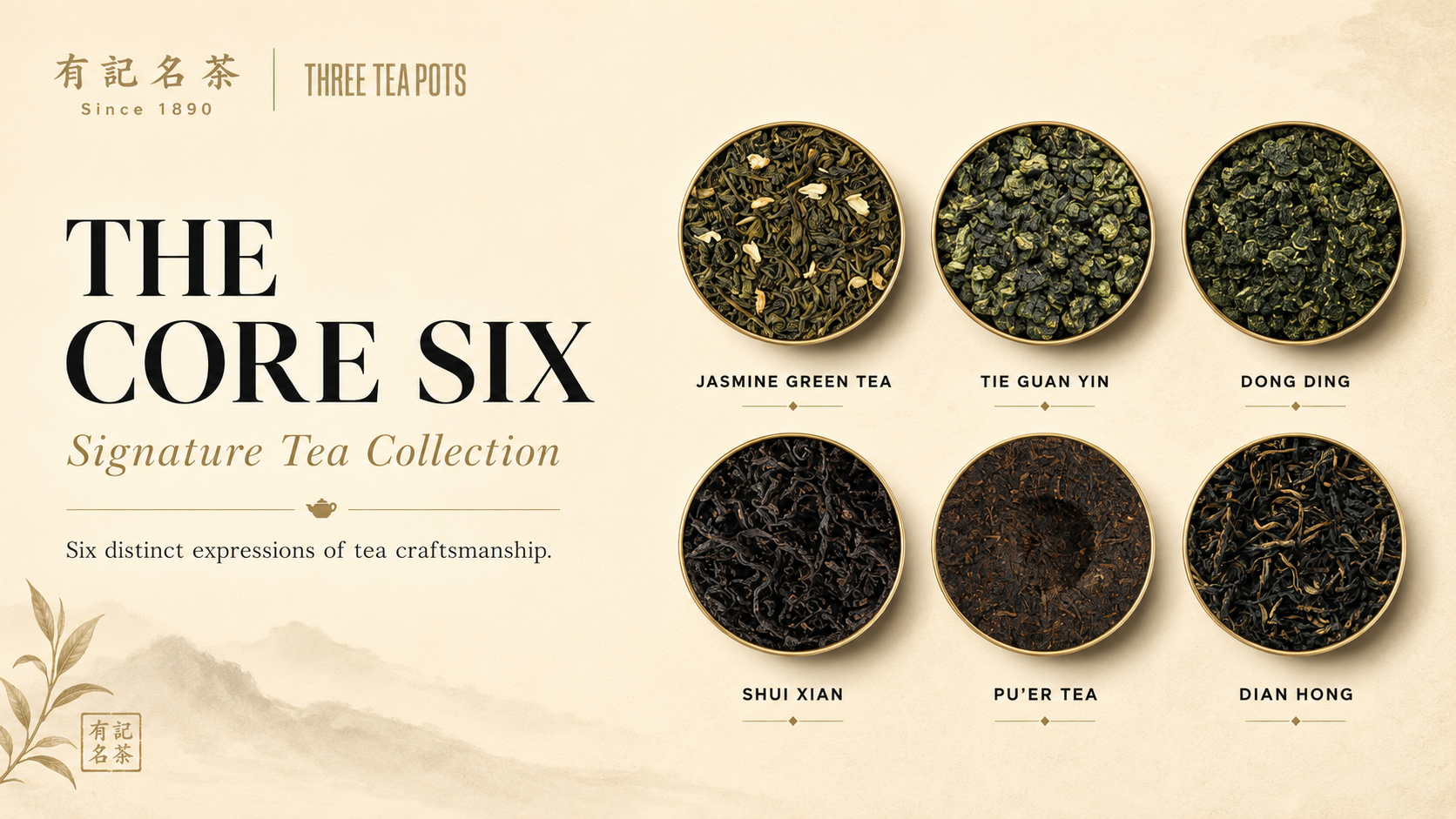
The Core Six Collection is our introduction to that spectrum.
Selected by THREE TEA POTS, the collection brings together six signature teas representing different origins, oxidation levels, processing styles and flavour profiles. From the bright fragrance of jasmine green tea to the deep, mellow character of aged Pu’er, every tea reveals a different side of tea craftsmanship.
Think of it as a six-track album. Each tea has its own rhythm, but together they tell a fuller story.
What Is the Core Six Collection?
The Core Six is a curated collection of the teas we believe every tea drinker should experience:
- Jasmine Green Tea
- Tie Guan Yin Oolong
- Dong Ding Oolong
- Shui Xian Oolong
- Aged Ripe Pu’er
- Dian Hong Black Tea
Rather than selecting six teas that taste similar, we chose teas that create contrast.
Some are refreshing and aromatic. Others are roasted, structured and full-bodied. Together, they offer a practical way to understand how origin, oxidation, roasting, fermentation and ageing shape the final cup.
Whether you are new to loose-leaf tea or already building a deeper appreciation for Chinese tea, the Core Six gives you a clear foundation.
Meet the Core Six
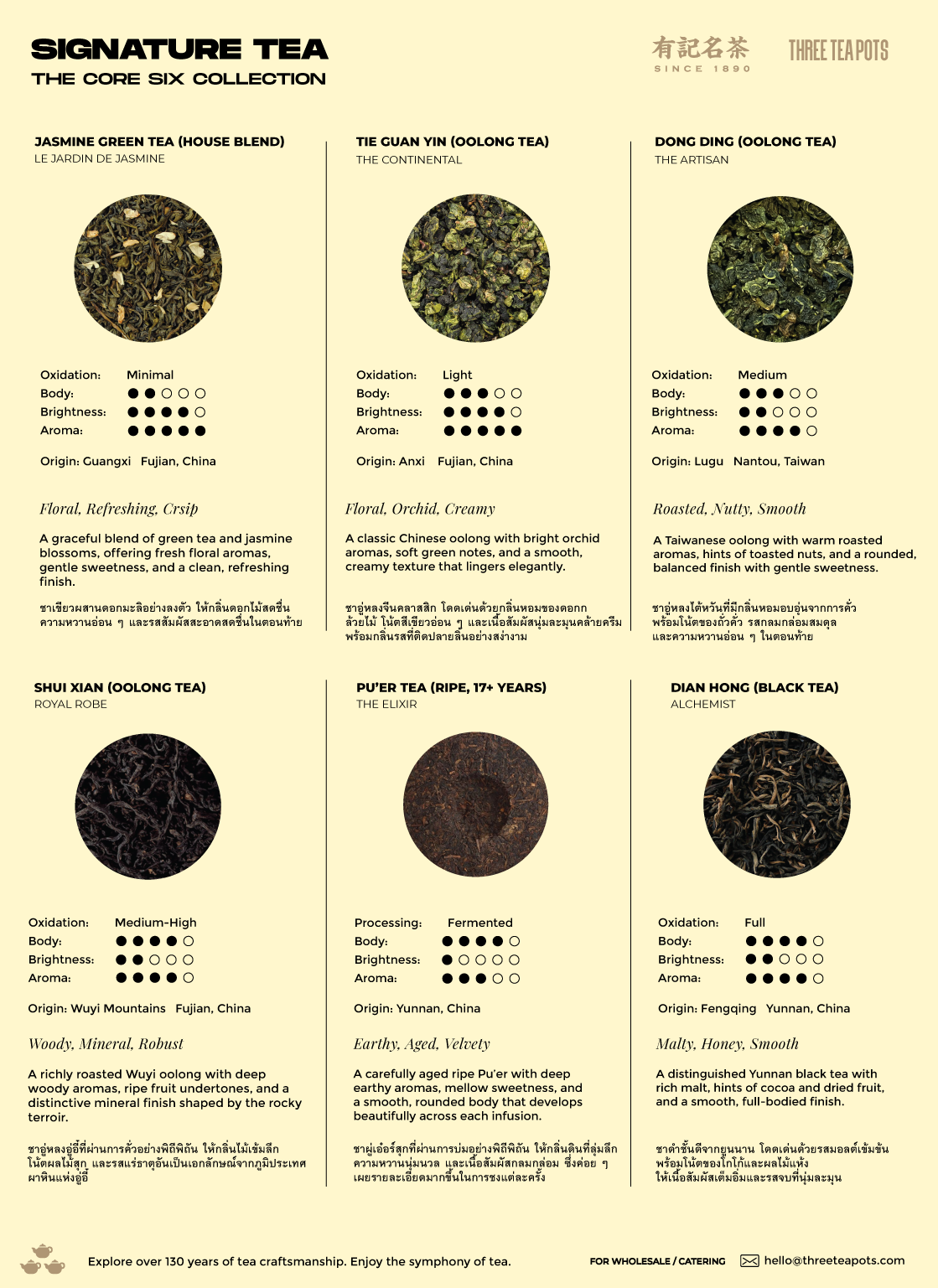
1. Jasmine Green Tea: Floral, Refreshing and Crisp
Our house jasmine tea combines green tea with fragrant jasmine blossoms, creating a graceful balance between freshness and floral aroma.
The tea is minimally oxidised, helping it retain its bright, clean character. Jasmine adds fragrance without completely covering the natural taste of the tea beneath it.
What it tastes like
Expect fresh jasmine florals, gentle sweetness and a crisp, refreshing finish.
Where it comes from
Our Jasmine Green Tea originates from Guangxi and Fujian, China, regions closely associated with jasmine cultivation and traditional scented-tea production.
Best for
This is an excellent starting point for people who enjoy light, aromatic and refreshing teas.
It also works beautifully as an afternoon tea, a palate cleanser or a cooling iced tea.
Flavour profile: Floral, refreshing, crisp
Oxidation: Minimal
Body: Light
Aroma: High
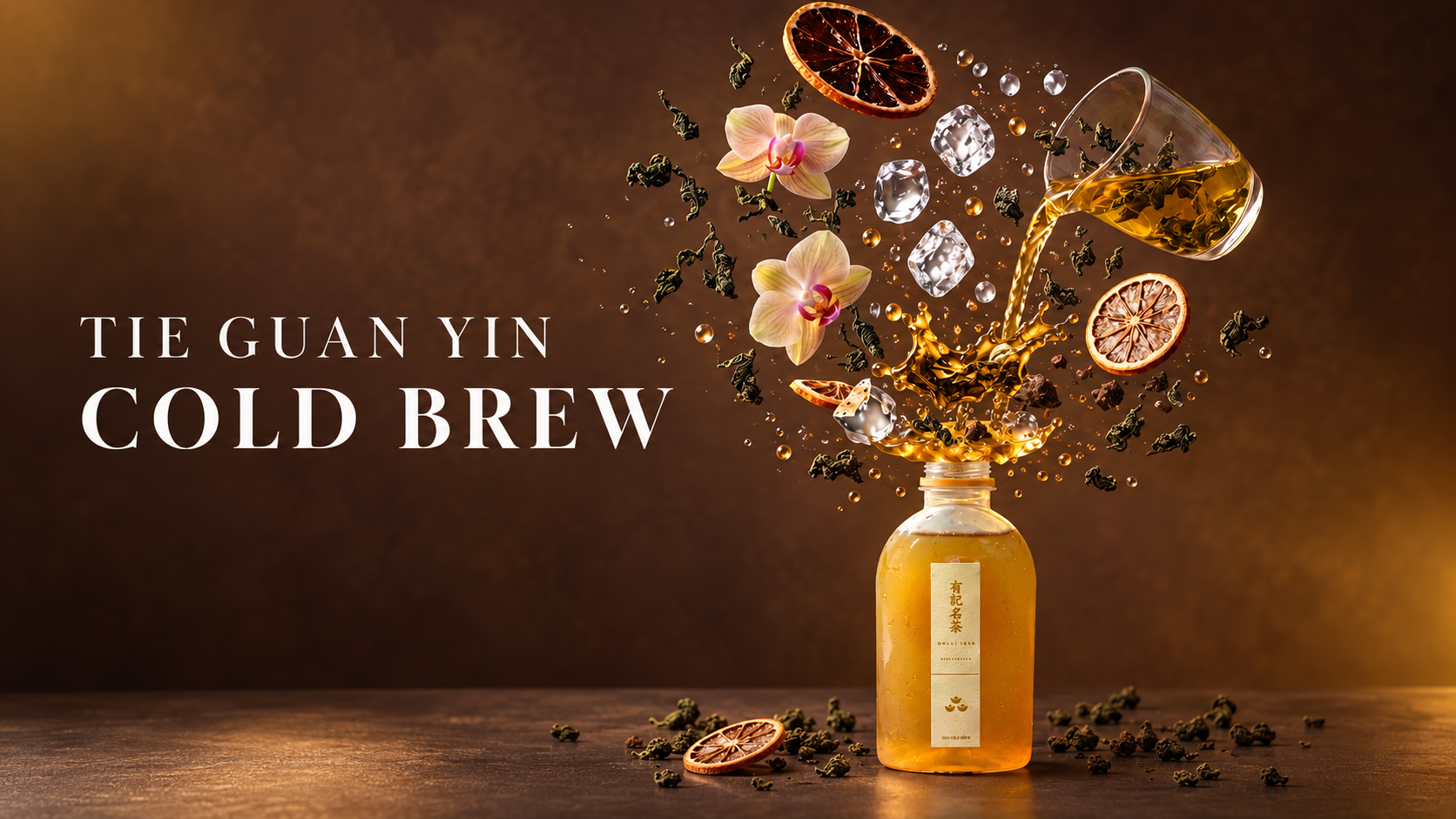
2. Tie Guan Yin: Floral, Orchid-Like and Creamy
Tie Guan Yin is one of China’s most recognised oolong teas.
Originating from Anxi, Fujian, it is traditionally valued for its expressive orchid fragrance, rounded mouthfeel and lingering sweetness.
Our Tie Guan Yin is lightly oxidised, allowing its greener and more floral characteristics to remain vivid. The result is elegant rather than heavy, with a smooth texture that makes the tea feel almost creamy.
What it tastes like
Bright orchid aromas, soft green notes and a smooth, buttery finish.
Why it matters
Tie Guan Yin demonstrates what makes oolong tea so fascinating.
It sits between green and black tea, combining freshness with greater aromatic complexity. It is neither fully green nor deeply oxidised. It occupies its own space.
Best for
Choose Tie Guan Yin when you want something fragrant, graceful and easy to drink across several infusions.
Flavour profile: Floral, orchid, creamy
Oxidation: Light
Body: Medium-light
Aroma: High
3. Dong Ding: Roasted, Nutty and Smooth
Dong Ding is a celebrated Taiwanese oolong traditionally associated with Lugu, Nantou County.
While Tie Guan Yin leans towards freshness and flowers, Dong Ding introduces warmth and roast.
The leaves are carefully processed and roasted, creating deeper aromas without losing the underlying sweetness of the tea.
What it tastes like
Warm roasted notes, toasted nuts, gentle sweetness and a rounded finish.
Why it matters
Roasting changes tea in the same way heat transforms raw ingredients in cooking.
Fresh green characteristics become warmer, softer and more developed. The tea gains depth, structure and comforting aromas.
Dong Ding is an ideal example of how skilled roasting can enhance a tea rather than overpower it.
Best for
This tea is well suited to people who enjoy roasted flavours, coffee, toasted grains or nutty desserts.
Flavour profile: Roasted, nutty, smooth
Oxidation: Medium
Body: Medium
Aroma: Medium-high
4. Shui Xian: Woody, Mineral and Robust
Shui Xian is a Wuyi rock oolong from the Wuyi Mountains of Fujian, China.
The Wuyi region is famous for its dramatic rocky landscape. The mineral-rich growing environment, combined with traditional roasting, gives these teas their unmistakable depth and structure.
Our Shui Xian is more powerful than the lighter oolongs in the collection. It carries darker aromas, greater body and a distinctive mineral finish.
What it tastes like
Deep woody aromas, ripe-fruit undertones and a strong mineral character shaped by the rocky terroir.
What is “rock tea”?
Wuyi oolongs are often called yan cha, or rock tea.
The name refers to teas grown within the rocky terrain of the Wuyi Mountains. Tea drinkers often describe the resulting character as mineral, structured or having a distinctive “rock rhyme.”
It is not the taste of stones. It is closer to the sense of place found in mineral water or wine grown in a particular soil.
Best for
Shui Xian is ideal for drinkers who prefer stronger tea, deeper roasting and a more structured finish.
Flavour profile: Woody, mineral, robust
Oxidation: Medium-high
Body: Full
Aroma: Medium-high
5. Aged Ripe Pu’er: Earthy, Mellow and Velvety
Our ripe Pu’er has been aged for more than 17 years.
Produced in Yunnan, China, ripe Pu’er undergoes controlled fermentation before ageing. Over time, its sharper edges soften, and the tea develops greater depth, smoothness and complexity.
Unlike green tea or lightly oxidised oolong, Pu’er is shaped not only by processing but also by time.
What it tastes like
Deep earthy aromas, mellow sweetness and a smooth, rounded body.
Why ageing matters
Ageing tea is not simply about making it older.
The quality of the original leaves, fermentation, storage conditions and time all influence the result. When these elements are handled well, the tea becomes more integrated and refined.
A well-aged Pu’er should not taste harsh or muddy. It should feel calm, layered and smooth.
Best for
This tea suits drinkers looking for something grounding, low in sharpness and deeply comforting.
It also pairs well with rich meals because its earthy character can refresh the palate.
Flavour profile: Earthy, aged, velvety
Processing: Fermented
Body: Full
Aroma: Medium
6. Dian Hong: Malty, Honeyed and Smooth
Dian Hong is a distinguished black tea from Fengqing, Yunnan, China.
The name is simple:
- Dian refers to Yunnan.
- Hong refers to red tea, the Chinese term for what is commonly called black tea in English.
Our Dian Hong is fully oxidised, giving it greater body, sweetness and depth than the greener teas in the collection.
What it tastes like
Rich malt, honey, cocoa and dried-fruit notes, followed by a smooth and full-bodied finish.
Why it stands apart
Many people associate black tea with bitterness or astringency. A high-quality Dian Hong can be remarkably soft and naturally sweet.
Its strength comes with warmth rather than aggression.
This makes it approachable for coffee drinkers while still offering the complexity expected from premium loose-leaf tea.
Best for
Choose Dian Hong when you want a richer, fuller tea with natural sweetness and satisfying body.
Flavour profile: Malty, honeyed, smooth
Oxidation: Full
Body: Full
Aroma: Medium-high